1. Historical Origins: Holy Soil and the Black Death
In 1278, Abbot Henry of the Cistercian monastery at Sedlec was sent to Jerusalem by King Otakar II of Bohemia. He returned with a jar of soil from Golgotha, which was scattered across the Sedlec abbey cemetery. This act elevated the site to one of Central Europe's most desirable burial locations.
Subsequent mortality spikes—the Black Death in the mid-14th century (burying over 30,000 plague victims) and the Hussite Wars of the early 15th century—filled the cemetery to capacity. When the Gothic church was built around 1400, an underground crypt was dug to serve as an ossuary for exhumed skeletal remains.
The 1870 Woodcarver Transformation
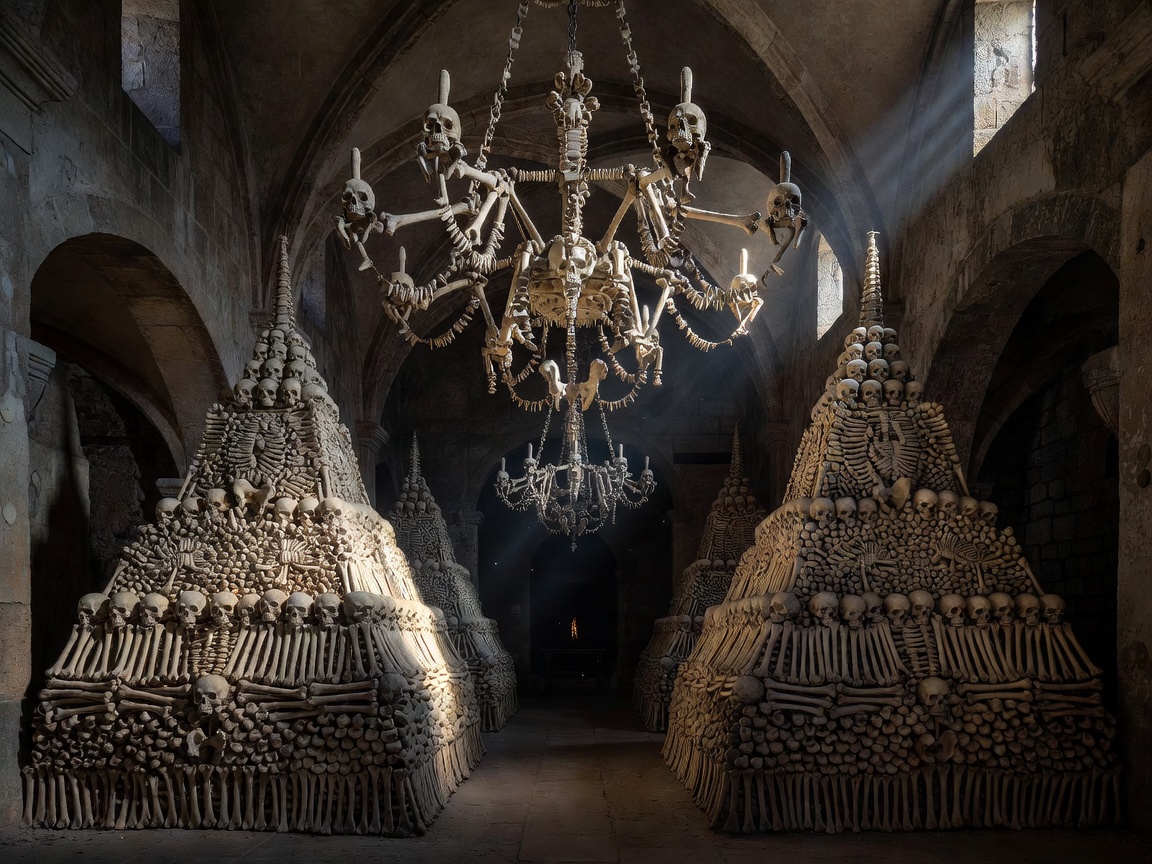
In 1870, the noble Schwarzenberg family commissioned woodcarver František Rint to arrange the disorganized piles of bones. Rint bleached the bones using chlorinated lime and assembled them into monumental forms, including four massive corner pyramids, the Schwarzenberg coat of arms, monstrances, and a central chandelier containing every bone in the human anatomy.
2. Conservation and Structural Engineering Challenges
The ongoing multi-million-euro restoration of the ossuary has exposed critical structural vulnerabilities:
- Structural Tilting: The outer Gothic walls of the upper chapel had tilted outwards up to 48 centimeters due to poor foundation drainage and centuries of ground settling.
- Pyramid Dismantling: To install subterranean structural supports and damp-proofing barriers, conservators had to systematically dismantle each of Rint's bone pyramids—documenting, cleaning, biocidally treating, and reconstructing over 10,000 bones per mound.
- Microclimatic Fluctuations: High visitor respiration rates introduce elevated relative humidity, condensation on bone surfaces, and mold spore colonies that damage fragile porous bone collagen.
3. Key Structural Components of the Crypt
| Element | Materials Used | Preservation State | Restoration Technique |
|---|---|---|---|
| Central Chandelier | Complete human skeletal sets, iron frame | Stabilized (dismantled and reassembled) | Micro-pinning, lime wash consolidation |
| Schwarzenberg Coat of Arms | Femurs, pelvises, skulls, scapulae | Stable; mounted on treated oak backboard | Non-invasive wire ligature anchoring |
| Four Corner Pyramids | Piled disarticulated crania & long bones | Restored between 2014 and 2024 | Internal stainless steel supporting mesh |
| Vault Ceiling Garlands | Strung vertebrae and phalanges | Protected from tactile interference | Climate-controlled air exchange filtration |
4. Visitor Management and Photography Restrictions
In January 2020, the Parish of Sedlec enacted a strict ban on unrestricted tourist photography inside the ossuary. Visitors are no longer permitted to take casual smartphone photos or selfies within the chapel without prior written authorization from the parish authority.
This regulation was enacted to curb inappropriate behavior (such as touching bones, placing hats on skulls, or posing theatrically) and to re-establish the chapel’s primary identity as a consecrated burial place and Christian memorial for deceased souls.
5. Comparative Evaluation: Osteological Tourism
Unrivaled artistic execution of baroque memento mori; provides funding for the structural preservation of the entire UNESCO-listed Kutná Hora heritage district.
Dense visitor footfall elevates ambient moisture levels, accelerating fungal growth on calcium phosphate surfaces and risking trivialization of consecrated remains.
6. Visiting Guidelines
Visitors must maintain silence, refrain from touching any skeletal arrangements or decorative fixtures, dress respectfully as for an active place of worship, and purchase combined tickets covering the nearby Cathedral of Our Lady and St. Barbara’s Church.