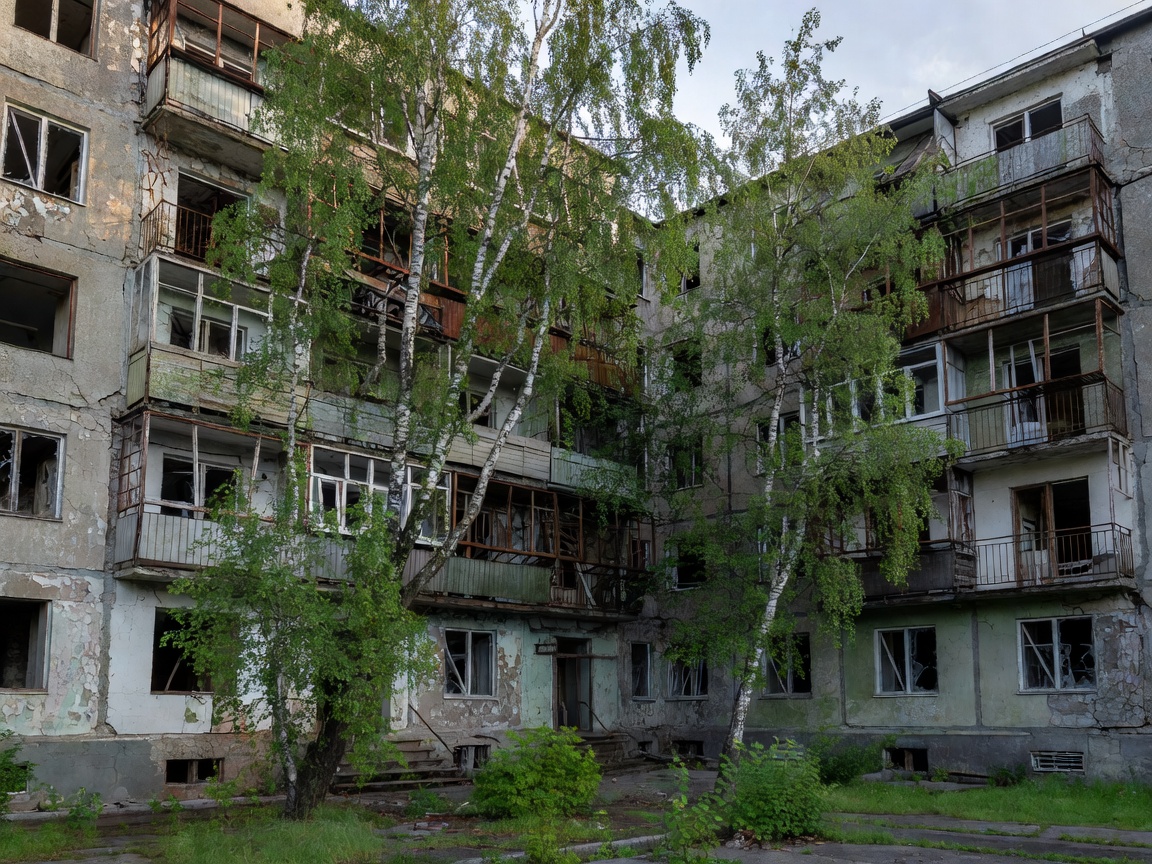
1. Historical and Spatial Framework
The disaster at the V.I. Lenin Nuclear Power Station released an estimated 5.2 exabecquerels of radioactive material into the atmosphere. The ensuing evacuation displaced over 116,000 residents immediately, creating a designated exclusion boundary governed by administrative checkpoints at Dytiatky, Leliv, and Kopachi.
Within the perimeter, two distinct urban centers exist: the town of Chornobyl, which houses shift workers, administrative staff, and monitoring scientists on rotating cycles; and the city of Pripyat, an atomgrad constructed in 1970 to house plant personnel, completely abandoned within thirty-six hours of the accident.
Radiological Containment: The New Safe Confinement (NSC)
Completed in 2016 and moved over Reactor 4 in 2018, the New Safe Confinement is an engineering arch measuring 108 metres high and 257 metres wide. It prevents water intrusion and radioactive dust release while robotic cranes dismantle the unstable 1986 concrete sarcophagus beneath.
2. Conservation and Structural Hazards in Pripyat
Visiting Pripyat presents substantial structural engineering hazards that now supersede routine external radiological exposure:
- Concrete Carbonation: Decades of unheated freeze-thaw cycles have degraded the reinforcement bars within standard Soviet prefabricated panel blocks.
- Roof Collapse: Flat-roof systems on primary schools, sports complexes (notably the Avanhard Stadium), and the Polissya Hotel have suffered severe structural failures due to water ponding and vegetative root expansion.
- Internal Dust Inhalation: While ambient gamma radiation on paved asphalt pathways has decreased significantly, enclosed interior spaces harbor concentrated pockets of contaminated dust containing alpha-emitting isotopes.
3. Comparative Profile: Access Modes & Regulatory Guidelines
| Site Sector | Typical Ambient Dose Rate | Structural Access State | Permit Tier Required |
|---|---|---|---|
| Dytiatky Checkpoint (Outer Ring) | 0.10 – 0.15 μSv/h (Baseline) | Roadside only; secure entry | Standard Zone Pass |
| Pripyat Town Square | 0.80 – 2.50 μSv/h | Exterior walkways only | Tier 2 Escorted Pass |
| Red Forest Perimeter | 10.0 – 45.0+ μSv/h | Transit only; stopping strictly banned | High-Radiological Clearance |
| NSC Reactor 4 Observation Point | 1.00 – 1.80 μSv/h | Paved memorial apron | Industrial Plant Permit |
4. Environmental Succession vs. Thanatourist Impact
The exclusion zone has evolved into an unintended ecological preserve. In the absence of human hunting and agriculture, populations of Eurasian wolves, Przewalski's horses, European bison, and brown bears have expanded across the Polesia radioecological reserve.
However, intense tourism prior to recent security closures created major preservation issues. Illegal scavenging, graffiti, staged photographic props (such as rearranged gas masks in School No. 3), and unmanaged forest fires caused by unauthorized visitors generated both cultural contamination and elevated atmospheric radiation resuspension.
5. Field Evaluation: Pros & Cons of Regulated Tourism Access
Generates international funding for decommissioning, maintains historic awareness of nuclear engineering hazards, and educates the public on radiation realities versus sensationalism.
Accelerates structural wear in unmaintained concrete buildings, risks unauthorized entry into high-contamination hot spots, and risks sensationalized "stalker" voyeurism.
6. Strict Visitor Safety Protocols
Permitted visitors must adhere to non-negotiable statutory rules: long sleeves, closed footwear, prohibition of sitting or placing equipment on bare soil, mandatory dosimetric screening at Leliv and Dytiatky checkpoints upon departure, and strict compliance with certified radiological guides.