1. The 18th-Century Public Health Crisis
During the late 18th century, Paris faced an unprecedented sanitary emergency caused by overcrowded municipal parish cemeteries, most notably the Cimetière des Saints-Innocents, which had operated for nearly a millennium.
In May 1780, a cellar wall adjoining Saints-Innocents collapsed under the weight of mass graves, spilling decomposing remains into private residential basements. In 1785, the State Council of King Louis XVI decreed the complete clearing of the cemetery and the transfer of its contents into the abandoned limestone quarries of the Tombe-Issoire sector.
The Inspection Générale des Carrières (IGC)
Established in 1777 by royal decree under engineer Antoine Guillaumot, the IGC mapped and consolidated the thousands of miles of unstable subterranean quarry voids. Between 1786 and 1814, nocturnal funeral processions transferred bones from Paris parishes into these reinforced underground galleries.
2. Osteological Masonry and The Hague Construction
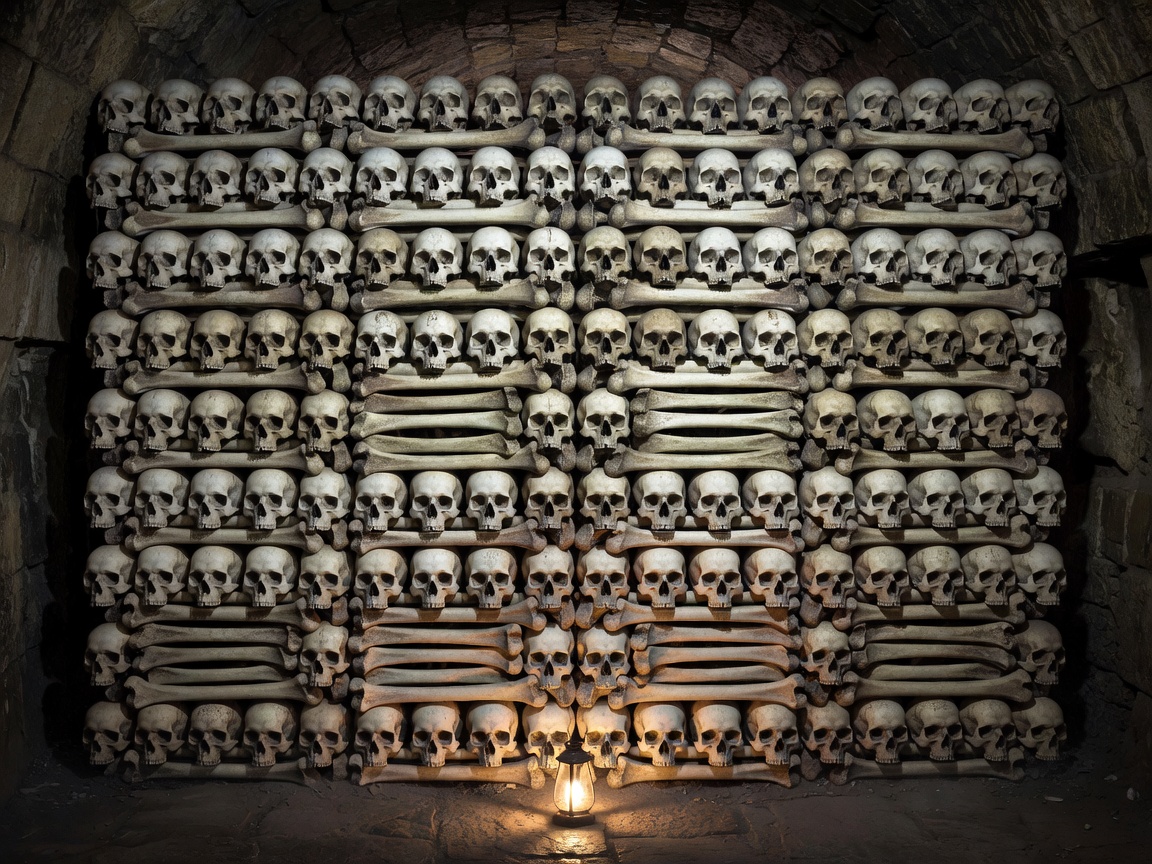
The interior arrangement of the Catacombs is not a random pile of bones, but an intentional decorative and structural architecture created by Mining Inspector Louis-Étienne Héricart de Thury starting in 1810:
- The Hague Technique: Front retaining walls (hagues) were built from stacked, interlocking long bones (femurs and tibiae) punctuated by decorative rows of skulls.
- Loose Infill Backing: Behind the neat osteological façades lie millions of smaller, disarticulated skeletal elements (ribs, vertebrae, phalanges, pelvic fragments) filling the void up to the limestone quarry ceiling.
- Architectural Monuments: Decorative memorial masonry was erected throughout the tunnels, including the Gilbert's Tomb, the Crypt of the Passion (featuring a barrel-shaped bone pillar), and the Sepulchral Lamp.
3. Environmental and Speleological Dynamics
| Environmental Factor | Underground Condition | Preservation Hazard | Engineering Mitigation |
|---|---|---|---|
| Relative Humidity | 80% – 95% | Bone mold and structural softenings | High-volume forced-air intake / exhaust ventilation |
| Water Infiltration | Limestone seepage fissures | Mortar washouts & bone calcification | Grouting injections and drainage channels |
| Structural Ground Load | Surface street traffic 20m above | Pillar shearing and ceiling spalling | Periodic acoustic load testing by IGC engineers |
| Visitor Heat Output | Limited to 200 persons inside at once | Microclimate temperature spikes | Strict automated timed ticket barriers |
4. The Illegal Subterranean Sphere (Cataphiles)
While the official public museum spans only 1.5 kilometres, the network of ancient quarry tunnels extends for over 280 kilometres beneath southern Paris districts.
A dedicated subculture known as cataphiles navigates unauthorized sections through clandestine utility shafts. This unauthorized access has led to graffiti, theft of skeletal elements, structural disruption, and emergency search operations, prompting regular underground sweeps by the dedicated "c-ta" police division.
5. Field Evaluation: Thanatourist Infrastructure
Transforms an eighteenth-century sanitary crisis into a premier educational study of municipal planning, classical literature inscriptions, and geological quarrying.
Challenging accessibility (131 descent steps and 112 exit steps without elevators); high humidity degrades historical informational signage and masonry.
6. Visitor Field Protocol
Strict bag checks are conducted at the exit (Place Denfert-Rochereau) to prevent bone theft. Touching remains is strictly prohibited. The route is unsuitable for persons with motor disabilities or severe respiratory conditions due to narrow passages and high humidity.